Paris court annuls MICAS residence orders blocking protest participation
More than 100 MICAS were reported against protesters, after Paris administrative judges struck down three cases.
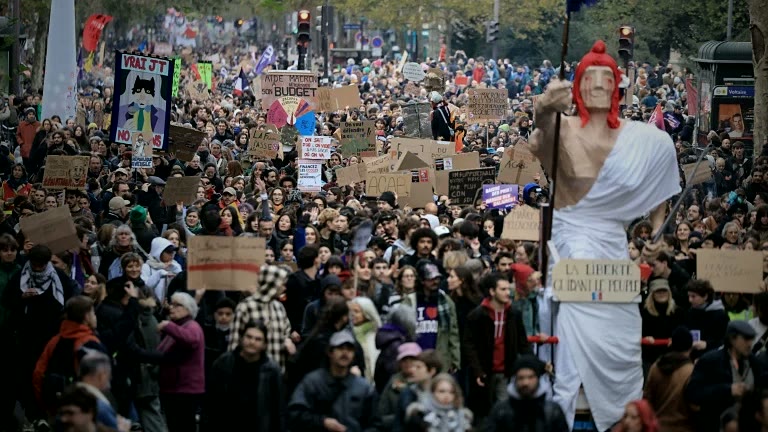
A French administrative court in Paris has annulled MICAS residence orders imposed on three people, measures used to restrict suspected terrorism-linked risks.
The ruling, issued on Tuesday 17 November, overturned MICAS adopted against three individuals. Lawyers told BFMTV that more than 100 individual MICAS had been taken against protesters in the weeks leading up to the decision, including those who wanted to take part in October and November mobilisations.
MICAS are individual administrative controls and surveillance orders created as a legacy of France's 2015 state of emergency. They are issued by the Minister of the Interior under the Code of Internal Security, aiming to prevent the commission of a terrorist act.
To impose a MICAS, two cumulative criteria must be met: there must be serious reasons to think the person's behaviour poses a particular threat to public security and order. In addition, the person must either have habitual links to terrorist people or organisations, or support, disseminate, or adhere to terrorist theses.
In practice, a MICAS can include restrictions such as being unable to leave a defined perimeter, with the area not allowed to be smaller than the commune's territory. Orders can also require reporting to a police station and proving an address, and may bar meeting certain people.
According to legal analysis cited by BFMTV, MICAS have mainly been used in two situations: where authorities suspected links to terrorism but lacked enough elements to proceed with criminal cases, and when people were released after convictions for terrorist-related offences.
In the three cases decided by the Paris administrative tribunal, the court said the Interior Ministry made an inaccurate application of the rules. It found that, in none of the three cases, the ministry characterized a threat to public order linked to the risk of committing a terrorist act. One case cited leading positions in protests and blocking a high school in October, while another referred to alleged provocative behaviour toward police during a sports demonstration in March 2025 and a case relating to a planned violent action against the Lyon-Turin high-speed rail project discussed in July 2026.
The latest status is that the MICAS imposed in these three cases have been annulled by the Paris administrative court.
ADVERTISEMENT
Source:
BFMTV Police-Justice